
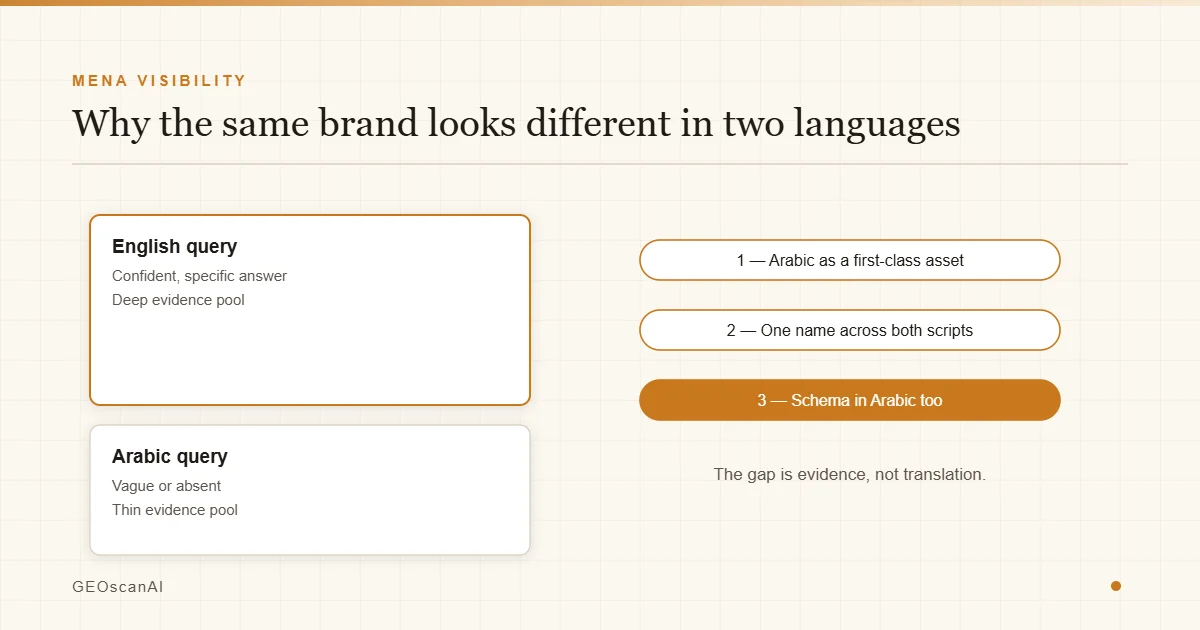
Arabic and English AI answers about the same MENA business often diverge sharply. These three fixes—content, identity, and schema—close most of that gap.
Ask ChatGPT the same question in Arabic and in English about a Cairo-based service business, and you'll often get two different answers, one confident, one vague or empty. That gap isn't random. It usually comes down to three fixable causes: thin Arabic-language source material, inconsistent naming across scripts, and structured content that exists in English but never got translated.
Why the Same Business Looks Different in Two Languages
AI engines don't have one unified understanding of a brand. They draw on language-specific pools of evidence, and for most MENA businesses, the English pool and the Arabic pool are wildly uneven. A company might have a well-optimized English site, a handful of English press mentions, and a polished investor-style profile, while its Arabic footprint amounts to a Facebook page and maybe a directory listing with an outdated phone number. When a model answers in Arabic, it's drawing from that thinner pool, and thinner evidence tends to produce vaguer, less confident answers, or no mention at all.
This isn't a translation problem in the simple sense. It's an evidence problem. A perfectly translated English page that only exists in English still doesn't help an Arabic-language query, because the model isn't translating your page on the fly, it's retrieving or recalling whatever already exists in the language the question was asked in.
Cause 1: There's Simply Less Arabic Source Material to Learn From
This is the most common cause, and the least glamorous to fix. English-language business content, especially for anything touching tech, e-commerce, or professional services, tends to be produced in far greater volume than its Arabic equivalent, even for businesses that operate primarily in Arabic-speaking markets. Review platforms, comparison articles, and press coverage all skew English by default in a lot of MENA categories, which means the accumulated evidence an AI model can draw on in Arabic is thinner almost everywhere, not just for smaller brands.
The fix isn't simply running your existing English pages through a translator and republishing them, although that's a reasonable start. It's making sure the Arabic version is genuinely something worth citing on its own, answers written the way an Arabic-speaking customer would actually ask the question, not a literal translation of an English-first phrasing.
Cause 2: Your Name Doesn't Match Itself Across Scripts
A surprising number of MENA brands are, from an AI model's perspective, several different entities. The Arabic name, its transliteration, and the English name may not be consistently linked anywhere online. If your business is known by one name in Arabic script, a slightly different transliteration on your English site, and yet another variant in your Google Business listing, a model trying to identify who this brand is in Arabic has a much harder job than it should.
This matters more for AI answers than it ever did for traditional search, because search engines got reasonably good at reconciling name variants over two decades of work. Generative engines are still catching up, and an unclear identity tends to get treated as lower confidence, which in practice means it gets left out of the answer entirely rather than guessed at.
Cause 3: Your Structured Content Stops at English
FAQ schema, product schema, and clearly structured question-and-answer content are exactly the kind of material AI engines lean on for extractable answers. Most MENA businesses that have invested in this kind of structured content have only done it in English, if they've done it at all. That means even a business with genuinely strong English-language AI visibility can be functionally invisible in Arabic, not because the underlying business information is missing, but because it was never packaged in a format the model could easily extract in the language it was asked in.
The Three Fixes That Actually Work
Fix 1: Build Arabic content as its own asset, not a translation task. Write Arabic FAQ and product content the way an Arabic-speaking customer phrases the question, rather than translating English copy word for word. Prioritize the highest-intent pages first, pricing, service descriptions, and comparison content, since these are the pages most likely to get pulled into an AI answer.
Fix 2: Unify your name across every surface, in both scripts. Pick one Arabic name, one consistent transliteration, and one English name, and make sure they appear together, explicitly linked, on your website, your Google Business profile, your social profiles, and any directory listing you control. Where possible, state the relationship directly, for instance noting the transliterated name alongside the Arabic name on your About page, so there's no ambiguity for a model trying to resolve them into one entity.
Fix 3: Duplicate your structured data into Arabic, not just your prose. If you have FAQ schema in English, build the Arabic equivalent as a genuine parallel asset, matched to the Arabic-language version of the page, not bolted onto the English page as an afterthought. This is often the single highest-leverage fix, because it directly targets the exact format AI engines favor for extraction.
Modern Standard Arabic vs. Everyday Dialect: A Nuance Worth Knowing
Arabic content optimization isn't a single target. Modern Standard Arabic, the formal register used across news media and most official web content, is what the bulk of crawlable Arabic source material is written in, and it's a reasonable default for FAQ and product content aimed at AI extraction. But the way real customers phrase questions, especially spoken-style questions typed into a chat interface, often leans toward dialect, Egyptian, Gulf, or Levantine, depending on the market. A model answering a dialect-phrased question is still drawing on a mostly Modern Standard Arabic evidence base, and the mismatch between how the question was asked and how the evidence was written can itself reduce match quality.
This doesn't mean rewriting your whole site in dialect. It means, at minimum, making sure your FAQ questions are phrased close to how customers actually type them, even if the answers stay in more formal Modern Standard Arabic. A question written in natural, slightly informal phrasing tends to match a wider range of real user queries than a stiffly formal one, and that match quality is part of what determines whether your content gets treated as a relevant answer at all.
What This Looks Like in Practice
- Businesses that treat Arabic content as a genuine first-class asset, rather than a translated afterthought, tend to close a meaningful share of the visibility gap between their English and Arabic AI answers, though the exact amount varies widely by category and competitive density.
- In our tracking across MENA brands, we've typically seen Arabic-language visibility scores start out well below English-language scores for the same business, in some cases by a wide margin, before any of these three fixes are applied, which is exactly the kind of engine-and-language breakdown GEOscanAI's scans are built to surface.
- A consistent name across scripts tends to matter more than most businesses expect, since an AI model uncertain about identity often defaults to omitting a brand rather than guessing.
- Structured Arabic content, once published, tends to take real time to show up in retrieval-heavy engines and even longer in trained-knowledge engines, so patience matters as much as effort here.
A Realistic Timeline
Don't expect an overnight shift. Fixing name consistency can help relatively quickly, since it removes ambiguity a model might already be tripping over. Building out genuine Arabic content and structured data is slower, both because it takes real production time and because AI engines need to discover, and in some cases learn from, that new content before it shows up in answers. A reasonable expectation is weeks for identity fixes to start helping, and a couple of months or more for freshly published Arabic content and schema to meaningfully move the needle, longer still for anything that depends on a future model training run rather than live retrieval.
Where to Start If You Can Only Fix One Thing This Quarter
If resources are limited, fix identity first. It's the cheapest of the three causes to address, it doesn't require new content production, and it removes a structural barrier that can otherwise blunt the effect of every other improvement you make. A business with excellent Arabic content but three inconsistent name variants across the web is still asking an AI model to do extra reconciliation work it may simply decline to do.
Once identity is unified, move to the highest-intent Arabic content gaps, typically pricing and service-description pages, before broadening to full FAQ and schema coverage. Trying to fix everything across a large site at once is usually a slower path to visible results than fixing the handful of pages that actually get asked about most.
The Takeaway
Arabic invisibility in AI answers isn't a sign that a business is doing something wrong so much as a sign that most of the MENA web simply hasn't caught up to English-language content depth yet. That's a gap, not a wall. Businesses that treat their Arabic presence as a real, first-class asset, rather than a compliance checkbox, are the ones most likely to close it before their competitors do.
Frequently asked questions
Why does my brand show up in English AI answers but not Arabic ones?
Usually because the AI model has far less Arabic-language material to draw from about your business than English material, even if your business operates primarily in Arabic-speaking markets. It's rarely a sign of a translation gap alone, it's an evidence gap.
Is it enough to translate my English pages into Arabic?
It helps, but it's rarely sufficient on its own. Content that reads like a direct translation of English phrasing often doesn't match how an Arabic-speaking customer would actually phrase a question, which limits how well it serves as extractable, citable evidence.
Does having different name spellings in Arabic and English actually hurt visibility?
It can, yes. When a model can't confidently link your Arabic name, its transliteration, and your English name to the same entity, it tends to treat your identity as lower confidence, and lower-confidence brands are more likely to be left out of an answer entirely.
How long does it take to see improvement after adding Arabic content and schema?
Identity fixes, such as unifying your name across platforms, can help within weeks. Genuinely new Arabic content and structured data typically take longer, often a couple of months or more, since engines need to discover and, in some cases, learn from that content before it shows up in answers.