
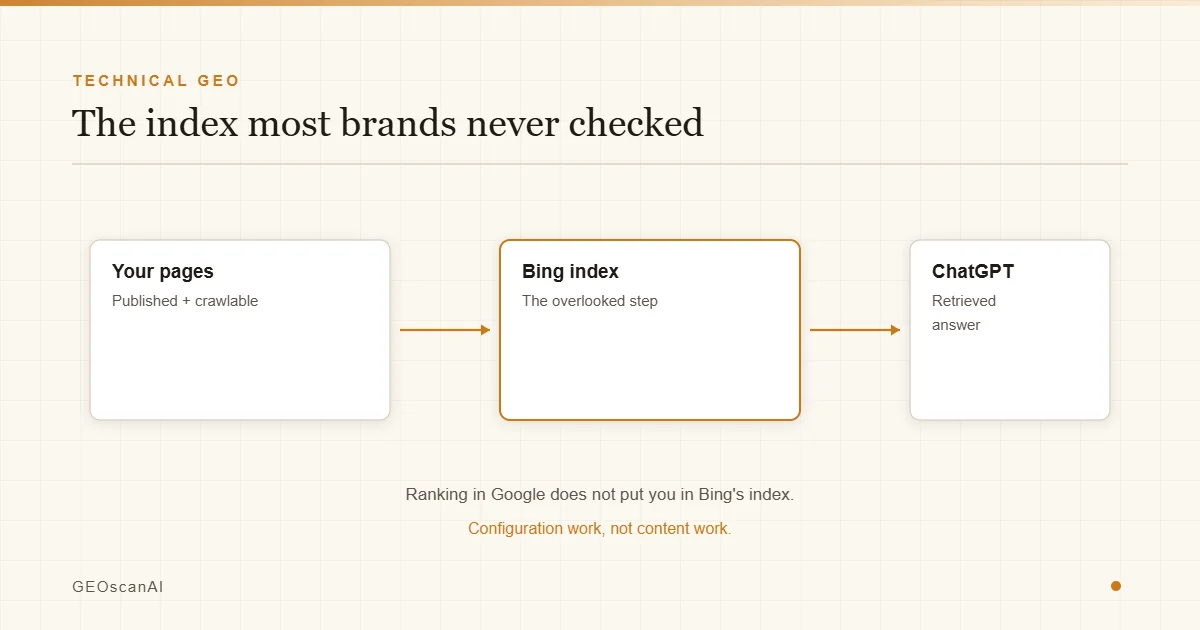
ChatGPT's retrieval layer leans on Bing's index for a meaningful share of current-web lookups. Ranking well in Google won't fix a Bing indexing gap.
Most GEO advice focuses on what ChatGPT itself surfaces, and skips the detail that a meaningful share of what ChatGPT retrieves at query time comes through Bing's index, not Google's. If your pages are strong in Google and thin in Bing, you may be far less visible to ChatGPT than your search rankings suggest.
Why Bing Matters to a Product You've Never Directly Used
Most businesses treat Bing as an afterthought, if they think about it at all. Global search share sits heavily in Google's favor, and it's reasonable for a marketing team to have never opened Bing Webmaster Tools. But OpenAI's retrieval infrastructure has, at various points, relied on Bing's index and search capabilities to power live web lookups inside ChatGPT, which means a page's standing in Bing can matter to AI visibility in a way it never mattered to ordinary search traffic.
This is the part that trips people up: you can be doing everything right for Google, ranking well, getting organic clicks, and still be functionally under-indexed in Bing, simply because nobody on your team ever checked. Bing indexing isn't automatic just because Google indexing happened.
How Bing Actually Feeds Into ChatGPT's Retrieval Layer
When ChatGPT needs current information, whether that's pricing, availability, or anything time-sensitive, it can trigger a retrieval step that pulls from indexed web content. The specific infrastructure behind that step isn't fully public and can change between releases, but the practical pattern practitioners have observed consistently is that a page's presence and freshness in Bing's index correlates with how likely it is to get pulled into a ChatGPT answer during that kind of query.
This doesn't mean Google indexing is irrelevant, plenty of AI visibility still traces back to content that was well-indexed and well-linked broadly across the web. It means Bing indexing is an additional, frequently overlooked lever, one most competitors in most categories haven't specifically optimized for, which makes it a comparatively easy area to gain ground in.
The Most Common Bing Indexing Gaps We See
A handful of gaps show up repeatedly. Sites that were built or migrated without ever submitting a sitemap to Bing Webmaster Tools, sites with a robots.txt file that inadvertently blocks Bingbot while allowing Googlebot, sites relying entirely on Google Search Console with no Bing equivalent set up at all, and sites where key pages simply haven't been recrawled by Bing in months because nothing ever prompted a recrawl. None of these are hard to fix. Most are a genuine oversight rather than a deliberate choice, which is exactly why they're common.
How to Get Properly Indexed in Bing
- Create a Bing Webmaster Tools account and verify ownership of your domain, using the same verification method you likely already used for Google Search Console.
- Submit your XML sitemap directly through Bing Webmaster Tools, rather than assuming Bing will discover it the way Google eventually does.
- Check your robots.txt file specifically for any rule that blocks Bingbot while allowing other crawlers, since this is a surprisingly common accidental gap.
- Use IndexNow, a protocol supported by Bing, to push instant notifications whenever you publish or update a page, rather than waiting for a routine recrawl.
- Monitor Bing Webmaster Tools' index coverage report on a regular cadence, the same way you'd already be checking Google Search Console, and investigate any pages showing as discovered but not indexed.
What Good Bing Indexing Looks Like, in Practice
- A properly indexed site typically shows the large majority of its submitted sitemap URLs as indexed in Bing Webmaster Tools, with only a small residual gap for pages genuinely not meant to be indexed.
- In our scans across brands that had never touched Bing Webmaster Tools before, we've typically seen a meaningful share of key pages either unindexed or stale by months, which is exactly the kind of gap GEOscanAI's technical checks are built to surface before it quietly caps a brand's ChatGPT visibility.
- IndexNow submissions tend to shorten the gap between publishing a page and that page becoming eligible for retrieval, compared to waiting on Bing's routine crawl schedule alone.
- Fixing a robots.txt block on Bingbot is usually the single fastest win available, since it can unblock indexing for an entire site in one change rather than requiring page-by-page work.
Common Misconception: "I Rank in Google, So I'm Fine"
This is the assumption that causes the most missed visibility. Google and Bing run separate crawlers, separate indexes, and separate ranking systems, and strong performance in one doesn't guarantee anything in the other. A site can rank on the first page of Google for its core terms and simultaneously have large sections poorly indexed, or not indexed at all, in Bing, often because nobody ever set up the equivalent tooling.
The businesses most exposed to this misconception tend to be ones that built their entire SEO practice around Google-specific tools and workflows, which is most businesses, understandably, since Google has dominated search share for so long that Bing-specific work has rarely felt worth the effort. AI retrieval changes that calculation, since it's pulling from infrastructure that doesn't map one-to-one onto where a marketing team has historically focused its attention.
What This Costs vs. What It Returns
The entire fix set described above is configuration work, not content production. For a team with existing website access, setting up Bing Webmaster Tools, submitting a sitemap, checking robots.txt, and wiring up IndexNow is typically an afternoon of focused work, not a multi-week project. That's a meaningfully different cost profile than most GEO recommendations, which usually involve writing new content, restructuring pages, or building out schema across a site.
Because the return is disproportionate to the effort, and because so few businesses have gotten around to it, Bing indexing tends to be one of the higher-leverage items on a GEO checklist for exactly the reason it's usually skipped: it doesn't feel urgent until you understand what it's actually connected to.
Compare that to a typical GEO priority list, adding FAQ schema across a product catalog, rebuilding thin category pages, or investing in third-party press coverage, and Bing indexing stands out as the rare item that's both cheap and fast. It's a reasonable candidate for whatever gets tackled first on a GEO roadmap, precisely because the other items on that list tend to take weeks or months to show any measurable effect, while a Bing indexing fix can start changing what ChatGPT retrieves within a much shorter window.
How Often to Recheck Your Bing Indexing Status
Indexing status isn't a one-time fix and forget. Sites change, pages get added and removed, robots.txt rules get edited by someone unaware of the earlier fix, and Bing's own crawl behavior shifts over time. A quarterly check of your Bing Webmaster Tools index coverage report is a reasonable baseline for most businesses, tightening to monthly if you publish frequently or if AI visibility is a specific priority this year.
It's also worth rechecking immediately after any site migration, domain change, or significant redesign, since these are exactly the events most likely to introduce a new accidental block or a sitemap that silently stopped updating. Treating Bing indexing as a periodic health check, rather than a box you tick once, is what keeps the fix from quietly decaying back into the same gap you started with.
A Second-Order Effect: Bing Feeds More Than Just ChatGPT
It's worth noting Bing's reach extends beyond any single AI product. Several AI assistants and browser-integrated tools beyond ChatGPT have, at points, drawn on Bing's index or search infrastructure for live lookups, which means fixing Bing indexing tends to be a one-time technical investment with more than one downstream beneficiary, rather than a narrow fix for a single engine. That's part of what makes it worth prioritizing even for teams stretched thin across a long GEO to-do list, since the effort spent here doesn't only pay off in one place.
The Takeaway
Bing indexing isn't a niche technical detail, it's one of the more overlooked levers in ChatGPT visibility specifically because so few brands have ever had a reason to think about Bing at all. Fixing it is comparatively low effort, mostly configuration rather than content production, and because so few competitors have bothered, the businesses that do it tend to see a disproportionate return relative to the work involved.
Frequently asked questions
Does Bing indexing really affect ChatGPT if my customers never use Bing search directly?
Yes, because the relevant mechanism isn't customers searching Bing themselves, it's ChatGPT's own retrieval infrastructure drawing on Bing's index behind the scenes when it needs current information. Your customers can be entirely unaware Bing is involved at all.
I already use Google Search Console. Do I really need Bing Webmaster Tools too?
For AI visibility specifically, yes. Google and Bing run separate crawlers and indexes, and strong Google indexing doesn't guarantee equivalent Bing indexing. Setting up Bing Webmaster Tools alongside your existing Google tooling is a low-effort, high-leverage step most competitors skip.
What is IndexNow, and is it worth setting up?
IndexNow is a protocol that lets you notify Bing, and other supporting search engines, the moment you publish or update a page, rather than waiting for a routine crawl to discover the change. For businesses that publish or update content regularly, it's generally worth the modest setup effort.
How do I know if Bingbot is being accidentally blocked on my site?
Check your robots.txt file for any disallow rule that specifically targets Bingbot, or a broad rule that unintentionally excludes it while allowing other crawlers. Bing Webmaster Tools also reports crawl errors that can surface this kind of block directly.