
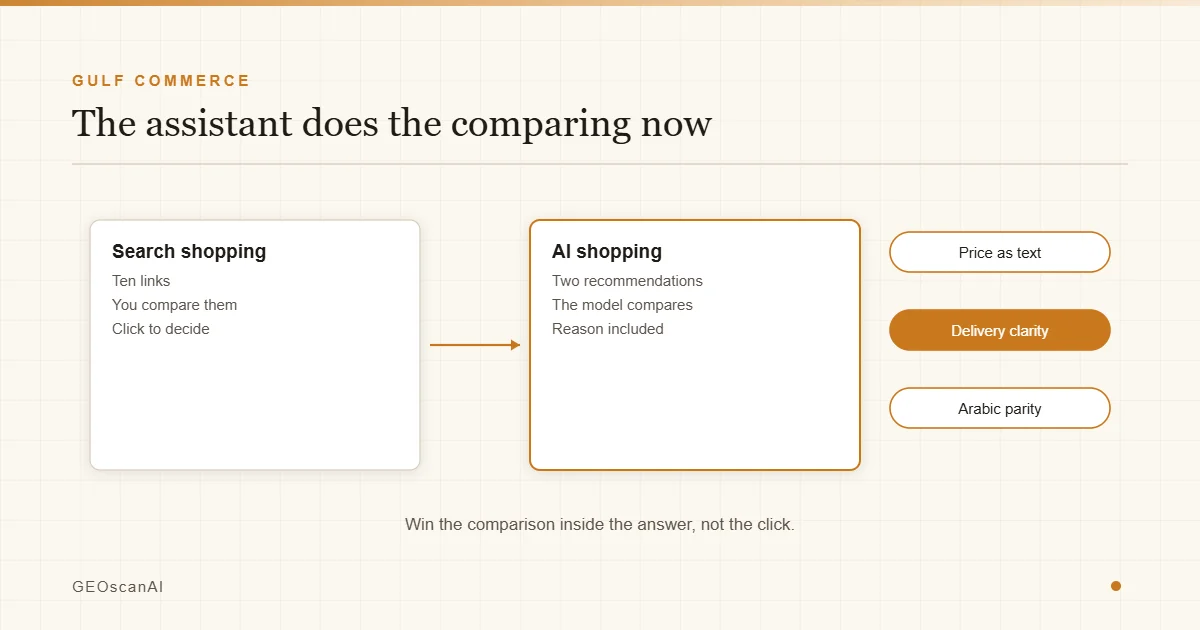
AI shopping assistants do the comparison work Gulf shoppers used to do themselves. Here's what MENA e-commerce product pages need to win that comparison.
Gulf shoppers increasingly start product research inside an AI assistant rather than a search bar, asking for a recommendation directly instead of browsing a list of links. For MENA e-commerce brands, that shift changes what ranking well even means, and most product catalogs simply aren't built for it yet.
Why AI Shopping Behaves Differently From Search Shopping
A traditional search result gives a shopper ten links and lets them compare. An AI shopping answer gives a shopper two or three recommended options, already synthesized, already framed with a reason. That means an AI assistant is effectively doing the comparison work a shopper used to do themselves, which means your product needs to win the comparison inside the model's answer, not just earn a click.
This changes what matters. A page that ranks well because of backlinks and domain authority, classic search-era signals, doesn't automatically translate into being the product an AI assistant recommends. What matters more is whether the model can confidently extract clear facts, price, availability, key specifications, delivery timeframe, and whether those facts hold up well against a competitor's equivalent page.
What AI Shopping Assistants Actually Need From a Product Page
Clear, current pricing, ideally marked up with Product schema, is the single most important factual anchor. An AI assistant fielding a price-sensitive question needs a confident number to work with, and a page without one, or with a number buried in an image rather than text, forces the model to either guess or skip the product entirely.
Availability and delivery timeframe matter more in Gulf e-commerce than in many other markets, given how much cross-border and next-day delivery expectations shape purchase decisions regionally. A product page that states delivery windows clearly and currently gives an AI assistant something concrete to compare against a competitor's page, rather than defaulting to generic assumptions.
Specifications need to be text, not just images. A beautifully designed product page with all its detail baked into a photograph or infographic is invisible to a model trying to extract facts from the page's actual text content.
The Gulf-Specific Wrinkles: Language, Currency, and Delivery Trust
Gulf shoppers frequently research in a mix of Arabic and English, sometimes within the same session, and product pages that only fully specify details in one language leave a real gap depending on which language a given AI query happens to be asked in. Currency display matters too, a page priced only in USD when the shopper is asking in a Gulf context introduces friction that a competitor pricing clearly in AED, SAR, or the locally relevant currency doesn't have.
Delivery trust is arguably the most Gulf-specific wrinkle. Cross-border e-commerce is common across the region, and shoppers are understandably cautious about customs, delivery timeframes, and return policies for anything shipped internationally. A product page that states its actual delivery and return terms clearly, rather than leaving them for a shopper to discover at checkout, gives an AI assistant a concrete, reassuring fact to include in its recommendation, and gives it something to compare favorably against a competitor who's vaguer about the same details.
A Practical Checklist for MENA E-commerce Catalogs
- Confirm every product page states its price as text, not only as an image, and mark it up with Product schema including currency.
- Publish delivery timeframes and return policy details directly on the product page itself, specific to the shopper's likely region, rather than requiring a click through to a separate policy page.
- Provide key specifications as readable text near the top of the page, not solely inside an image gallery or downloadable spec sheet.
- Build out genuine Arabic-language versions of your highest-traffic product and category pages, matched to how Gulf shoppers actually phrase product questions, not machine-translated as an afterthought.
- Collect and display recent, genuine customer reviews where possible, since review recency and volume are among the trust signals that help an AI assistant choose between otherwise similar options.
Where Reviews and Third-Party Trust Fit In
Reviews do double duty here. They're a trust signal a model can point to directly when recommending a product, and they're also a source of exactly the plain-language product description a model favors, since real customer reviews tend to describe a product the way an actual shopper would ask about it, filling gaps that formal product copy often misses.
Third-party coverage, comparison articles, regional marketplace listings, and category roundups, matters similarly. A product that only exists on the brand's own site has a thinner evidence base than one that also shows up, consistently described, across a few credible third-party sources a model might draw on.
How This Differs From Optimizing for Google Shopping
Teams with an established Google Shopping practice sometimes assume the same feed-optimization work transfers directly to AI shopping visibility. Some of it does, accurate structured pricing and availability data matters in both contexts, but the two aren't equivalent. Google Shopping ranks primarily on feed quality, bid strategy, and product-title keyword matching, optimized for a comparison grid a shopper scans visually. An AI assistant isn't scanning a grid, it's synthesizing a short recommendation from whichever page or feed data it trusts most, which puts more weight on narrative clarity, delivery and return transparency, and third-party corroboration than a shopping feed alone typically carries.
In practice, this means a catalog that's been heavily optimized for Google Shopping feeds can still underperform in AI shopping recommendations if the underlying product pages themselves are thin on the kind of plain-language, trust-building detail an AI assistant weighs more heavily. The two efforts complement each other, but neither substitutes for the other, and treating AI shopping optimization as an extension of an existing Shopping feed project, rather than its own distinct effort, tends to leave real visibility on the table.
Common Mistakes MENA E-commerce Brands Make
The most common mistake is treating the Arabic site as a lighter, secondary version of the English one, missing specifications, thinner descriptions, or an outdated product catalog compared to the English equivalent. An AI assistant answering an Arabic-language shopping question is working from whichever version actually exists in Arabic, so a thin Arabic catalog directly caps AI shopping visibility in that language, regardless of how strong the English catalog is.
A second common mistake is burying critical facts, price, delivery timeframe, return policy, behind a login wall, a chat widget, or a multi-click checkout flow rather than stating them plainly on the product page itself. Anything a model would need to click through several steps to find is effectively invisible to it.
A third, subtler mistake is inconsistent stock and pricing data between the site and whatever a model may have indexed or learned previously. A product marked in stock on the live page but described as discontinued or out of stock in an AI answer erodes trust fast, even when the live page is the accurate one, since the shopper has no easy way to know which source to believe.
What Getting This Right Looks Like in Practice
- MENA e-commerce catalogs that publish clear, text-based pricing and delivery details in both Arabic and English tend to show up more consistently in AI shopping recommendations than catalogs that only fully specify one language, based on patterns we've observed across tracked brands.
- In our scans of Gulf-region e-commerce sites, we've typically seen a meaningful share of product pages missing text-readable specifications entirely, relying instead on images, which is exactly the kind of extractability gap GEOscanAI's technical checks are built to flag.
- Delivery and return clarity tends to be an underused differentiator, since relatively few competitors state these terms plainly at the product-page level, making it a comparatively easy way to stand out in an AI assistant's comparison.
- Recent, genuine reviews compound with clear product facts, since they reinforce the same information from an independent voice, which tends to help both retrieval-based and trained-knowledge-based engines treat a product as a credible recommendation.
The Takeaway
AI shopping assistants are doing the comparison work Gulf shoppers used to do themselves, which means the product page's job has shifted from persuading a human browser to giving a model clear, extractable, bilingual facts to compare confidently. MENA e-commerce brands that treat their Arabic catalog, their delivery clarity, and their text-readable specifications as first-class priorities are the ones best positioned to be the product an AI assistant actually recommends.
Frequently asked questions
Do AI shopping assistants actually influence Gulf e-commerce purchases yet?
Adoption varies by category and by shopper, but AI-assisted product research is a growing part of how Gulf shoppers start researching purchases, particularly for higher-consideration categories. Treating it as a near-term priority rather than a distant trend is the safer assumption for most MENA e-commerce brands.
Is it enough to have an Arabic version of my site if it's thinner than the English version?
Not really. An AI assistant answering an Arabic-language shopping question works from whatever exists in Arabic specifically, so a thinner Arabic catalog directly limits AI shopping visibility for Arabic-language queries, regardless of how complete the English catalog is.
Why does delivery and return policy clarity matter so much for AI shopping recommendations?
Because Gulf e-commerce involves a lot of cross-border shopping, and shoppers are understandably cautious about customs, timeframes, and returns. A product page that states these terms plainly gives an AI assistant a concrete, reassuring fact to include, and something to compare favorably against a vaguer competitor.
Do customer reviews really affect whether an AI assistant recommends a product?
They can, in two ways: as a trust signal a model can point to directly, and as a source of natural, plain-language product description that often fills gaps formal product copy misses. Recent, genuine reviews tend to help more than older or sparse review counts.