
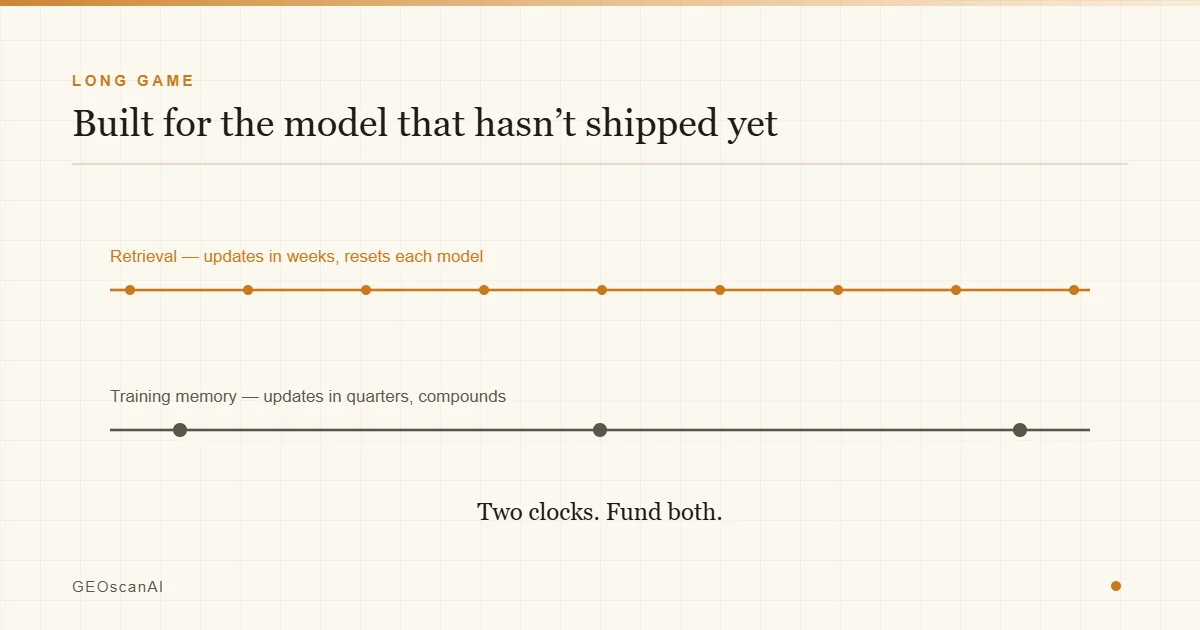
Retrieval-path fixes win the current model. Durable, corroborated presence across the web is what wins the next one, and the one after that.
Every piece of GEO advice about fixing your site today is implicitly a bet on retrieval, the current model noticing the current version of your page. There's a second, slower game worth playing at the same time: getting durably into whatever the next model generation remembers, regardless of whether it ever crawls your site live at all.
Two Different Games: Today's Retrieval and Tomorrow's Training
Retrieval-path optimization, fixing crawlability, adding schema, keeping pages current, pays off on the timeline of the current model generation. It's the more immediate, more controllable lever, and most GEO advice, reasonably, focuses there. But a meaningful share of how AI models talk about brands, particularly for engines and use cases that lean on trained knowledge rather than live lookup, is shaped by what made it into training data, and training happens on a schedule you don't control, informed by a snapshot of the web you can't edit after the fact.
Playing only the retrieval game means every improvement resets somewhat with the next model generation, since a new model's baseline knowledge is, again, whatever made it into that particular training run. Playing the memory game means building a durable presence that compounds across model generations, rather than needing to be re-won with every release.
Why "Memory" Is the Right Word, Even Though It's Imprecise
Model training isn't memory in the human sense, there's no single moment a model consciously decides to remember your brand. It's closer to statistical reinforcement: the more consistently and clearly a fact about your brand appears across the training corpus, the more reliably it gets encoded into what the model can accurately reproduce later. A brand mentioned once, in one obscure source, barely registers. A brand mentioned consistently, accurately, and clearly across many independent sources has a much stronger claim on the next model's baseline knowledge.
That's close enough to memory as a working concept, even if the underlying mechanism is statistical rather than deliberate. The practical implication is the same either way: durability and consistency across many sources matter more than a single, perfectly optimized page.
What Actually Gets Remembered
Based on how these models behave in practice, a few kinds of content seem to have outsized durability. Content that's been stable and consistent for a long time, rather than recently changed, tends to be more reliably reflected, simply because it's had more training cycles to be reinforced. Content that's corroborated across multiple independent sources, your own site, a review platform, a press mention, a directory listing, all describing the same fact the same way, tends to be trusted more than a claim that only exists in one place. And content that's structurally clean, a clear FAQ answer, a plainly stated fact, rather than buried in dense marketing prose, seems to survive the training process more intact than something a model has to infer from context.
This doesn't mean chasing volume for its own sake. A hundred low-quality, inconsistent mentions of your brand across the web are probably less useful than a dozen clear, consistent, corroborating ones.
Why This Requires Patience Most Marketing Teams Don't Budget For
Here's the uncomfortable part: there's no reliable way to know exactly when the next training run's cutoff will land, or precisely what it will absorb. A fact published today might influence the very next model generation, or it might take multiple release cycles to show up clearly, depending on timing you don't control and can't observe directly. Most practitioners should assume a lag of several months to well over a year between publishing something durable and seeing it clearly reflected in a training-based model's answers.
That timeline doesn't fit neatly into a quarterly marketing plan, and it's part of why memory-focused work tends to get deprioritized in favor of retrieval-path fixes that show results faster. The fix isn't abandoning the faster work, it's treating memory-building as a standing, ongoing allocation, not a project with a deadline you can point to.
What to Build for Memory, Specifically
Durable third-party coverage sits at the top of the list: press mentions, credible review platforms, comparison articles, and any directory or reference source likely to persist and get re-crawled repeatedly over time. A Wikipedia-adjacent presence, where genuinely warranted and maintained according to that platform's own standards, is a particularly durable signal, since Wikipedia and similar reference sources are disproportionately represented in training corpora relative to their share of the general web.
Consistency across your own properties matters as much as external coverage. If your official description of what you do has changed three times in two years, a model trained across that period may have encoded a blended, less accurate version of any of those descriptions. Settling on a clear, stable description of your category and positioning, and keeping it consistent for as long as it remains true, gives training data less conflicting signal to reconcile.
A Common Mistake: Optimizing Only for What You Can See Move
The natural pull of any measurement-driven discipline is toward the things you can actually see move. Retrieval-path metrics update within weeks, which makes them satisfying to report on and easy to justify budget for. Memory-path work produces no visible movement for months, sometimes longer, which makes it an easy line item to cut when budgets tighten, even though it's arguably the more durable investment of the two.
Brands that only fund what shows immediate movement tend to end up in a cycle of re-winning the same retrieval-path ground with every model update, while competitors quietly building durable, corroborated third-party coverage compound an advantage that doesn't reset each cycle.
Reframing How You'd Explain This Internally
If this framing is hard to sell internally, it can help to describe it less as SEO for a future product and more as reputation infrastructure. Most organizations already understand, intuitively, that a consistent, well-documented public reputation pays off over years rather than weeks, whether or not AI models are involved. Memory-path GEO work is close to that same instinct applied to a new kind of audience, one that happens to be a model rather than a person, but that still rewards the same underlying qualities: consistency, corroboration, and patience.
A Sanity Check: This Isn't Just Theoretical
It's fair to ask whether any of this is observable rather than speculative. The honest answer is partially. Practitioners can compare how confidently and accurately different models describe brands with long, well-corroborated public histories against brands with thin, recent, or inconsistent coverage, and the pattern holds up reasonably well across informal testing: older, more consistently documented brands tend to get described more accurately and more confidently. What's harder to observe directly is the specific mechanism, exactly how much weight any single source carries, or precisely which training cycle absorbed which fact, since that level of detail isn't published by any model provider. Treat the broad pattern as reasonably well-supported and the specific mechanics as directionally useful rather than precisely known, and calibrate how much certainty you attach to any single claim about how training works accordingly.
What This Looks Like for a Brand Doing It Well
- Brands with a multi-year history of consistent, corroborated third-party coverage tend to show up with more confident, more accurate framing in trained-knowledge-heavy engines than brands of similar size with a thinner, more recent footprint, based on patterns we've observed across tracked categories.
- In our audits, we've typically seen younger or smaller brands undervalue exactly this kind of durable coverage relative to their spend on faster-moving retrieval-path fixes, which is a reasonable short-term choice but a gap worth planning to close, and it's part of why GEOscanAI tracks trained-knowledge indicators separately rather than folding them into a single score.
- A stable, unchanging core description of what a brand does, maintained for years rather than rewritten with every rebrand cycle, appears to correlate with fewer blended or outdated descriptions showing up in trained-knowledge answers.
- None of this replaces retrieval-path work, the two are complementary investments on different timelines, not competing priorities.
The Takeaway
The next model generation's baseline understanding of your brand is being written right now, by whatever's consistently and credibly said about you across the web today, whether or not you're thinking about it. Retrieval-path fixes win the current model. Durable, corroborated, consistent presence wins the next one, and the one after that. Both are worth funding, on their own separate timelines, rather than treating one as a substitute for the other.
Frequently asked questions
Can I directly influence what a future AI model "remembers" about my brand?
Not directly or precisely, since you don't control training schedules or exactly what gets included. What you can influence is the consistency and corroboration of what's said about your brand across many sources, which appears to correlate with more accurate, more confident representation in future models.
How long does it take for new content to affect a trained-knowledge model like Claude?
There's no fixed timeline, and it depends on training schedules you don't control. Most practitioners should assume a lag of several months to well over a year between publishing something durable and seeing it clearly reflected, which is why this is described as a long-term investment rather than a quick fix.
Should I stop focusing on retrieval-path fixes in favor of memory-building?
No, they're complementary, not competing. Retrieval-path fixes affect current model behavior on a much faster timeline, while memory-building is a longer-term investment in future model generations. Most brands need both, funded on their own separate timelines.
Does a Wikipedia presence really matter that much?
Where genuinely warranted and properly maintained according to Wikipedia's own standards, yes, it tends to be a disproportionately durable signal, since reference sources like Wikipedia are heavily represented in training corpora relative to their share of the general web. It's not a substitute for broader third-party coverage, though, just one strong component of it.