
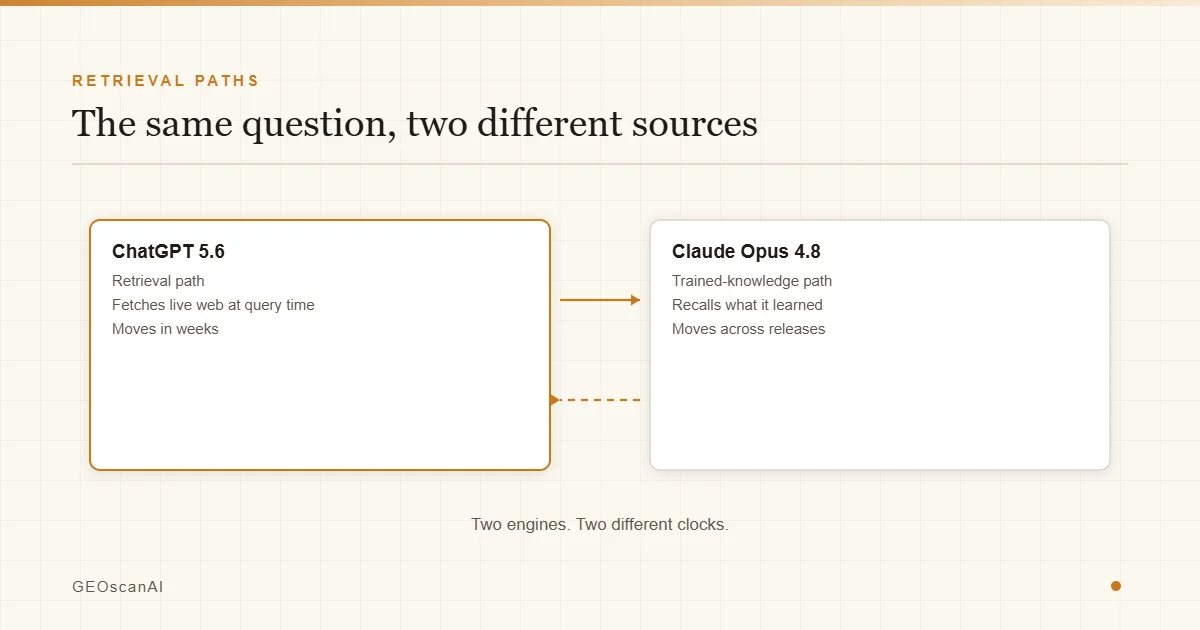
Claude and ChatGPT retrieve brand information through different paths. Understanding both retrieval paths is the first step toward being reliably cited across engines.
Claude and ChatGPT don't pull brand information from the same place, and that's the whole reason the same question can produce two different shortlists. ChatGPT 5.6 leans harder on content it can retrieve at the moment you ask — live search, browsing, indexed pages. Claude Opus 4.8 leans more on what it already knows from training, supplemented by whatever tools a given deployment gives it. Optimize for only one of those paths and you're only half-visible.
Two Models, Two Different Jobs for the Web
It helps to stop treating "getting cited by AI" as one task and start treating it as two related but separate tasks, because the underlying mechanics genuinely diverge.
ChatGPT 5.6, particularly in its default consumer and API configurations, is built to reach outward. When someone asks about a category of product or service, the model frequently triggers a retrieval step — pulling in current web pages, weighing freshness, and constructing an answer that reflects what it just found. This is why a page that ranks well in traditional search, loads quickly, and states its claims clearly tends to have an outsized effect on ChatGPT visibility. The model is, in a meaningful sense, reading your site in something close to real time.
Claude Opus 4.8 behaves differently by default. A large share of what it "knows" about your brand was absorbed during training, not fetched during the conversation. That knowledge is necessarily older — training cutoffs mean Claude's baseline understanding of a smaller or newer brand can lag behind what's actually true today. Where Claude has tool access such as search or browsing, it can supplement that baseline the way ChatGPT does by default. But absent tools, you're competing for a seat in the model's trained memory, not for a slot in a live index.
What Each Path Actually Rewards
What ChatGPT's retrieval path rewards. Fresh, crawlable, clearly structured content wins here. If your pricing page was updated last month and answers "how much does this cost" in a clean sentence near the top, that page is a strong retrieval candidate. Schema markup, fast load times, and a Bing-indexed presence — Bing feeds more of the retrieval layer than most brands assume — all compound in this path. The practical upshot: technical SEO fundamentals matter more here than most GEO commentary gives them credit for.
What Claude's trained-knowledge path rewards. Breadth and durability of mentions across the open web, over time, matter more than freshness. A brand that's been written about consistently — in review sites, comparison articles, third-party roundups, industry press, directory listings — builds up an accumulated presence that shows up in what the model learned, not what it fetched. This path is slower to move. Publishing a great new page today won't shift Claude's baseline understanding until a future training run absorbs it, and most practitioners should assume that lag runs anywhere from several months to well over a year, depending on release cadence.
Where the Two Paths Quietly Overlap
The two paths aren't opposites — they share a foundation. Clear, unambiguous brand identity, meaning a consistent name, a consistent description of what you do, a consistent category, helps both a live retrieval step and a training run correctly identify and trust you. Third-party mentions help both paths too: they're crawlable today, which helps ChatGPT, and they'll likely still exist at the next training cutoff, which helps Claude. Structured FAQ content tends to serve both paths well, since it's exactly the kind of clean, extractable format a retrieval system favors and that summarizes cleanly enough to survive into training.
Where the paths genuinely diverge is in what "getting it right today" buys you. Fix your retrieval-path signals and you can plausibly see different ChatGPT behavior within weeks, once caches and indexes catch up. Fix your training-path signals and you're building for the next model generation, not this one.
A Working Checklist for Both Paths
- For the retrieval path (ChatGPT): confirm your key pages are indexed in Bing, not just Google, keep pricing and product-fact pages current, add FAQ and Product schema where genuinely applicable, and answer common buyer questions in plain sentences near the top of the page rather than burying them in marketing copy.
- For the trained-knowledge path (Claude): invest in durable third-party coverage such as reviews, comparison roundups, press, and a maintained directory presence, since this is what accumulates into the next training snapshot.
- For both: keep your brand identity unambiguous. A business that goes by three slightly different names across its own site, its LinkedIn, and its review profiles makes both retrieval and training-time identification harder than it needs to be.
- In our testing across a range of B2B and consumer categories, we've typically seen roughly a third to a little over half of tracked brand-relevant prompts return a citation from at least one AI engine — GEOscanAI's engine-by-engine breakdown is built specifically to show which path, retrieval or trained-knowledge, is actually driving your visibility on each one.
- Track separately, not together. Because the two paths move on different timelines, a single blended "AI visibility score" can hide a real problem, such as strong ChatGPT presence masking a Claude blind spot that won't close no matter what you publish this quarter.
How to Check Which Retrieval Path Is Working for You
- Ask the same buyer-intent question, worded identically, to both ChatGPT and Claude, and note whether your brand is named in each response.
- If a citation appears, check whether it points to a page you control and how recently that page was updated. A citation to a page you updated in the last few weeks is a strong sign the retrieval path is active.
- Confirm your most important pages are indexed in Bing, using Bing Webmaster Tools or a simple site search, since ChatGPT's retrieval layer draws more heavily on Bing than most brands expect.
- Compare a page published in the last few weeks against an older, established page. If only the older page gets cited, you're most likely seeing the trained-knowledge path rather than live retrieval.
- Repeat the test monthly and track the two paths separately. Retrieval-path visibility can shift as pages are re-crawled, while trained-knowledge visibility will typically look flat between model releases.
A Common Mistake: Chasing Whichever Metric Moves First
Because the retrieval path moves faster, it's tempting to treat ChatGPT visibility as the whole scoreboard. You make a change, you see movement within weeks, and it feels like progress. Claude's slower trained-knowledge path doesn't offer that same immediate feedback, so it's easy to quietly deprioritize it, or assume it's already fine simply because nobody's watching it closely.
The problem shows up later. A brand that spends a year optimizing exclusively for fast retrieval-path wins can end up with a strong ChatGPT presence and a Claude presence that's barely moved, sometimes worse, if a competitor picked up more durable third-party coverage in the meantime. Because Claude's next meaningful shift depends on a future training run rather than this week's crawl, that gap doesn't close on its own, and it doesn't announce itself the way a dip in ChatGPT citations would.
The fix isn't complicated, just unintuitive: budget effort for the slow path on purpose, on a schedule, independent of whether you can see it move yet. Durable coverage is the kind of work that looks like it's doing nothing for months and then shows up all at once, whenever the next training snapshot catches up to it.
The Timeline You Should Actually Expect
Because the retrieval path can update quickly and the trained-knowledge path can't, it's worth setting expectations before you start. Fixing crawlability, schema, and page-level answer clarity can shift ChatGPT-style visibility within weeks for a brand that's already reasonably well indexed. Improving Claude-style visibility is a longer game. You're planting signals for a training run that hasn't happened yet, and results can take a couple of quarters or more to show up, and even then only partially, since older training data doesn't simply disappear. Brands that treat GEO as a one-time fix tend to notice their ChatGPT numbers move first and their Claude numbers barely move at all, and wrongly conclude the work didn't take. It worked, for one path. The other one is still catching up on its own schedule.
The Takeaway
Retrieval and training aren't competing strategies, they're two different clocks. Optimize your live, crawlable presence for the engines that fetch in real time, and treat durable third-party coverage as your investment in the engines that learn once and remember for a while. Brands that only do one tend to look strong on one engine and strangely absent on another, and most people never figure out why until they start measuring the two paths separately.
Frequently asked questions
Does Claude Opus 4.8 browse the web the same way ChatGPT does?
Not by default in most deployments. ChatGPT 5.6 more routinely triggers live retrieval during a conversation, while Claude Opus 4.8 leans more on its trained knowledge unless a specific tool or connector is enabled. Where Claude does have browsing or search tools available, its behavior moves closer to a retrieval-based answer, but the baseline default still differs meaningfully between the two models.
If I improve my website today, how fast will that show up in Claude's answers?
Slower than in ChatGPT's, in most cases. Because a large part of Claude's brand knowledge comes from training rather than live retrieval, changes you make today typically won't shift its baseline answers until a future training run absorbs them, a lag that commonly runs from several months to well over a year depending on release cadence, not a fixed guarantee.
Is Bing indexing really relevant if my customers use Google?
Yes, indirectly. ChatGPT's retrieval layer draws more heavily on Bing's index than most brands assume, so a page that's strong in Google but weak or absent in Bing can still be invisible to ChatGPT's live retrieval step, even though your traditional search visibility looks healthy.
Should I track ChatGPT and Claude visibility as one combined score?
We'd recommend against it. Because the two paths move on different timelines and respond to different signals, a single blended score can mask a real gap, for example solid ChatGPT citation rates hiding a Claude blind spot that won't close no matter what you publish this month.