
AI answers don't produce a ranked list, so rank tracking doesn't translate. Here are the metrics, and the framework, that actually replace it.
There's no scoreboard in AI search the way there was in Google, no single position to check every morning. That doesn't mean AI visibility is unmeasurable, it means the metrics have to shift from rank to something closer to share, consistency, and framing.
Why "Rank" Doesn't Translate to AI Answers
Traditional SEO gave you a number: position three for a keyword, position one for another. That number was stable enough to track daily and comparable enough to report to a boss without much explanation. Generative answers don't work that way. The same prompt, asked twice, can surface a different set of brands, in a different order, with different framing, even without anything on your site changing. There's no single canonical answer to compare against, because the model isn't returning a ranked list, it's generating a response.
This is genuinely disorienting for teams used to rank tracking, and it's part of why AI visibility measurement gets dismissed as impossible or vague. It's neither. It just requires different metrics built for a genuinely different kind of output.
The Metrics That Actually Replace It
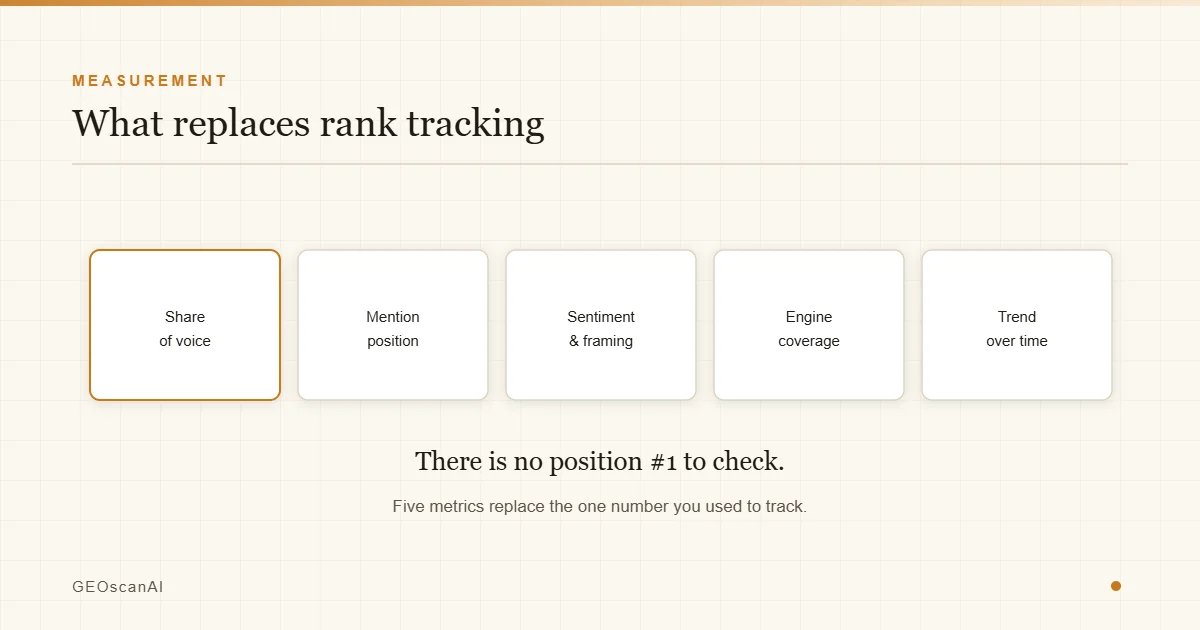
Share of voice. Across a defined set of buyer-relevant prompts, what percentage of total brand mentions did you capture, relative to every vendor who showed up at all? This is the closest analogue to rank, since it measures your competitive position rather than your absolute presence.
Mention position. When you do appear, are you named first, buried in a list of five, or mentioned only in passing? Position within an answer carries real weight, since a first-mentioned brand is more likely to be the one a reader actually acts on.
Sentiment and framing. Being named isn't the same as being recommended. A brand can appear in an answer that frames it neutrally, positively, or with a caveat, and that framing matters as much as the mention itself.
Engine coverage. Are you visible on one engine and invisible on the others? A blended score can hide a real gap here, since strong ChatGPT presence and weak Gemini presence produce a very different customer experience depending on which engine a given buyer happens to use.
Trend over time. A single snapshot tells you almost nothing on its own, since answers vary run to run. What matters is the direction of movement across a consistent prompt set, tracked on a regular cadence.
Building a Measurement Framework, Step by Step
- Define a fixed set of buyer-intent prompts that reflect how real customers actually ask, not just your target keywords rephrased as questions, and keep this set stable so results are comparable over time.
- Run that same prompt set across every AI engine relevant to your market, at minimum the two or three your customers are most likely to use.
- For each response, record whether your brand appears, where it appears in the answer, and how it's framed, not just a binary yes or no.
- Repeat the same prompt set on a consistent cadence, at least monthly, since a single run is a snapshot, not a trend.
- Compare results over time and by engine, rather than collapsing everything into one blended score, so you can see which engine or which prompt category is actually driving movement.
What a Healthy Measurement Cadence Looks Like
- Monthly measurement is a reasonable floor for most businesses; weekly tracking is worth the extra effort for teams actively working on GEO and wanting earlier signal on whether specific changes are working.
- In our tracking across brands running consistent prompt sets, we've typically seen visibility scores move by a modest amount month over month for brands not actively working on their signals, and by a noticeably larger amount for brands making deliberate changes, which is the kind of before-and-after comparison GEOscanAI's trend view is built to surface.
- A prompt set that never gets refreshed eventually stops reflecting how customers actually ask questions, so revisiting the prompt list itself on a quarterly basis is worth building into the process.
- Comparing your trend line against a competitor's, where visible, tends to be more useful than comparing against an abstract benchmark, since what counts as a good score varies enormously by category and competitive density.
Common Mistakes When Measuring AI Visibility
The most common mistake is treating a single spot-check as a measurement, asking a model one question once and drawing a conclusion from it. Given how much answers can vary between runs, one data point tells you almost nothing reliable.
A close second is testing only branded prompts, questions that already include your company name, rather than the category and buyer-intent questions a customer would actually ask before knowing your brand exists. Branded-prompt visibility tends to look artificially strong, since you're essentially asking the model to talk about you by name, which understates the real gap for anyone not already aware of you.
A third mistake is measuring once and never again, treating a single audit as a finished project rather than an ongoing practice. AI models update, competitors improve their own signals, and a snapshot from six months ago tells you very little about where things stand today.
Why a "Blended" Score Is Worse Than No Score
It's tempting to compress everything above into a single number, one composite AI visibility score, purely because it's easier to report upward. Resist that urge, or at least don't rely on it exclusively. A blended score that averages share of voice, position, and sentiment across every engine can look stable even while masking a real, worsening problem on one specific engine, because a gain somewhere else in the blend quietly offsets the loss.
This matters most when the underlying causes differ by engine. A drop in ChatGPT visibility might trace to a technical indexing issue, while a Claude gap traces to thin third-party coverage. Those require entirely different fixes, and a single blended number gives no indication of which fix to prioritize, or that two separate problems exist at all. Keep the blended score, if stakeholders want one for a quick glance, but always keep the underlying breakdown available and check it regularly, not just when the blended number moves.
Reporting AI Visibility to Stakeholders Who Expect a Single Number
Leadership audiences often want the simplicity a rank tracker used to provide, one number, one trend line, done. That's a reasonable ask, and it's fine to lead a report with a summary score. The mistake is stopping there. Pair the top-line number with two or three sentences of context, which engine moved, in which direction, and what specific change, if any, is believed to be driving it. This keeps the report honest about a genuinely more complex underlying reality without burying a non-specialist audience in five separate metrics they didn't ask for.
Over time, as a reporting cadence matures, most teams find it useful to keep a simple internal record of what changed and when, a new page published, a schema rollout, a press mention, so that later movement in the trend line can actually be attributed to something specific rather than treated as unexplained noise.
Turning Measurement Into a Habit, Not a Project
The frameworks above only pay off if they're run consistently, which is the part most teams underestimate at the outset. A one-time audit produces a single data point, and a single data point can't show a trend no matter how carefully it was collected. Treating AI visibility measurement the way you'd treat analytics, a standing, recurring practice rather than a quarterly special project, is what turns the framework into something that actually informs decisions rather than something that gets run once and filed away.
None of this requires exotic tooling to get started. A spreadsheet, a fixed prompt list, and a recurring calendar reminder can produce a genuinely useful trend line within a couple of months, well before any specialized measurement platform becomes necessary. The discipline of running the same prompts consistently, month after month, matters far more than the sophistication of whatever tool ends up tracking them.
The Takeaway
AI visibility measurement isn't unmeasurable, it's just built on different primitives than rank. Share of voice, mention position, framing, engine coverage, and trend, tracked consistently against a stable prompt set, replace the single number a rank tracker used to give you, and arguably tell you more about your actual competitive position than a single search ranking ever did.
Frequently asked questions
If AI answers vary between runs, how can visibility even be measured reliably?
By running a consistent, defined set of prompts repeatedly over time rather than relying on any single response. Individual answers vary, but the trend across a stable prompt set, tracked monthly or more often, produces a reliable enough signal to act on.
What's a good AI visibility score to aim for?
There's no universal number, since what counts as strong varies significantly by category and how many competitors are actively working on their own AI visibility. The more useful comparison is against your own past scores and against direct competitors' scores where visible, rather than an abstract benchmark.
Should I only track prompts that include my brand name?
No, that tends to overstate your real visibility. Branded prompts show whether a model can describe you when directly asked, but category and buyer-intent prompts, the kind a customer would ask before knowing your brand exists, are a better measure of whether you're actually getting discovered.
How often should I re-run my AI visibility measurement?
Monthly is a reasonable minimum for most businesses. Teams actively working on GEO improvements often track weekly to catch earlier signal on whether specific changes are having an effect, and it's worth refreshing the underlying prompt set itself roughly quarterly.