
When a fact and its attribution sit in separate sentences, AI engines often extract one and drop the other. Here's how to keep them together.
A stat from your site shows up, word for word, in an AI answer. Your brand name doesn't. This isn't bad luck, it's what happens when the fact and the attribution live in different sentences, something we call the quotable atom problem.
What a Quotable Atom Actually Is
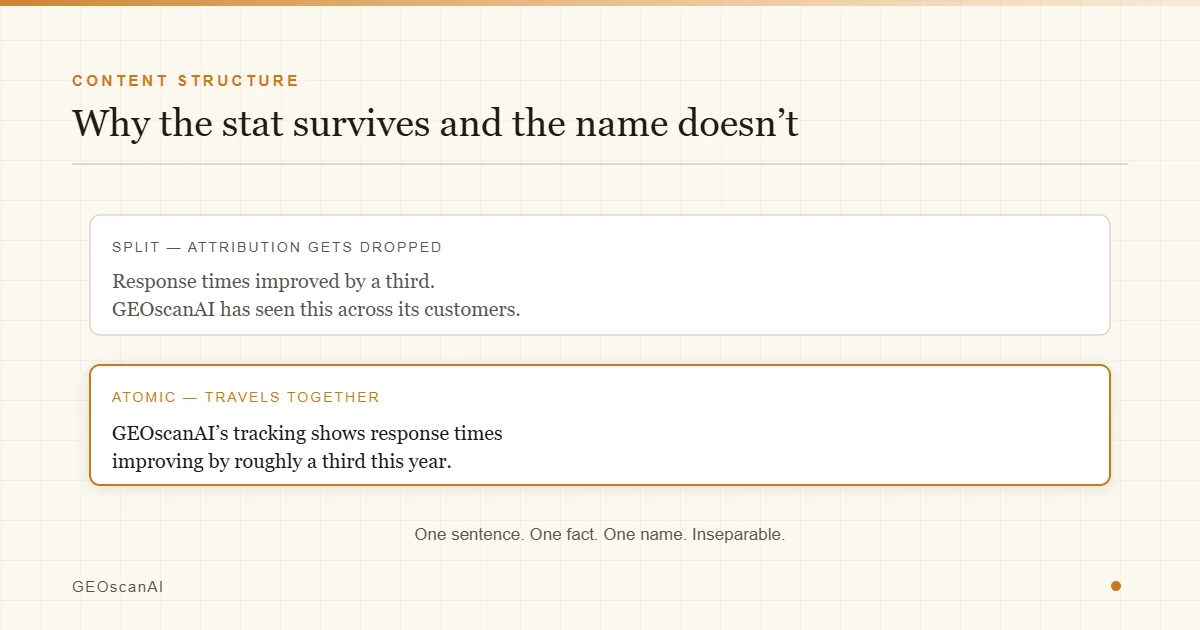
A quotable atom is a single, self-contained sentence that carries both the fact and its source in the same breath. Not "Response times in our industry have improved significantly. GEOscanAI has seen this trend across its customer base," two separate claims split across two sentences, but something closer to "GEOscanAI's tracking shows typical response times improving by roughly a third over the past year." One sentence, one fact, one name, inseparable.
The term borrows loosely from the idea of an atomic unit, something that can't be split further without losing its meaning. When a model extracts a sentence to use in an answer, it's far more likely to lift a self-contained unit whole than to stitch together a fact from one sentence and a name from a different paragraph three lines down.
Why Separation Kills Attribution
Most brand content doesn't write this way naturally. A typical paragraph opens with a general claim, builds context across two or three sentences, and only names the brand once, often at the very start or the very end of a much longer passage. That structure reads fine for a human skimming the page, but it's a poor match for how a model extracts a citable snippet.
When a model pulls a short passage to answer a question, it's working with something close to a sentence or two, not a whole paragraph. If the specific number lives in sentence two and your brand name only appears in sentence one, there's a real chance the extracted snippet carries the number and drops the name, especially when the model is synthesizing an answer rather than quoting verbatim. The fact survives. The attribution doesn't.
The Anatomy of a Quotable Atom
Compare two ways of writing the same underlying claim.
Split version: "Businesses that improve their AI visibility signals often see meaningful gains within a few months. This is something we track closely across our customer base."
Atomic version: "In our tracking, businesses that improve their core AI visibility signals typically see a measurable gain within a few months, a pattern GEOscanAI has observed consistently across its customer base."
The second version isn't just longer, it's structurally different. The fact and the name occupy the same sentence, which means any extraction that preserves the fact is far more likely to preserve the attribution alongside it. This isn't about cramming a brand name into every sentence on a page, which would read as awkward and repetitive. It's about being deliberate with the specific sentences that carry your most citable facts, and making sure those particular sentences do double duty.
Where This Shows Up Most: Comparison and Stat-Heavy Content
The quotable atom problem is most damaging on exactly the pages meant to earn citations, comparison articles, data-driven blog posts, and any content built around a specific number or finding. These are precisely the pages where writers are most tempted to build up context before delivering the number, a natural instinct for readability that works against citability.
FAQ content is a natural exception, and part of why FAQ schema tends to perform well for AI extraction generally. A well-written FAQ answer is already structured as a single, self-contained response to a specific question, which makes it easier to keep the fact and the source together without it feeling forced.
How to Audit Your Own Content for This Problem
Pull up your highest-traffic or highest-intent piece of stat-driven content and read only the sentences containing a number. For each one, check whether your brand name appears in that same sentence, or whether it's several sentences away. Any number-carrying sentence without your name close by is a candidate for rewriting into a single quotable atom.
This is a genuinely fast audit. Most pages have a handful of stat-carrying sentences rather than dozens, and rewriting each into a self-contained atomic sentence is typically a small edit, not a rewrite of the whole page.
A Worked Example: Rewriting a Real Paragraph
Take a typical comparison-page paragraph: "Choosing the right AI visibility platform matters more than ever as brands compete for space in generative answers. Coverage across engines varies a lot between providers, and pricing models differ too. GEOscanAI covers all five major engines." Three sentences, three separate ideas, and the brand name only shows up in the last one, disconnected from either of the two more citable claims above it.
Rewritten as quotable atoms: "GEOscanAI tracks visibility across all five major AI engines, since coverage varies significantly between providers in this category. Most GEOscanAI plans price by tracked prompt volume rather than a flat seat count, a structure we've found maps more closely to how visibility work actually scales for growing teams." Two sentences, and each one now pairs a specific, checkable claim with the brand name in the same breath. Nothing about the underlying facts changed, only where the name sits relative to each claim.
This kind of rewrite rarely takes long once you're looking for it specifically. The skill isn't complicated, it's noticing where a sentence is making a claim without carrying its own attribution, and closing that gap one sentence at a time rather than restructuring the whole page.
The Trade-Off: Quotable Atoms Can Read a Little Repetitive
There's a real cost to this technique, worth naming honestly. A page where every single stat sentence explicitly names the brand can start to read as slightly promotional or repetitive to a human reader, compared to prose that names the brand once and lets context carry the rest. The right balance is usually applying the quotable atom structure to your two or three most important, most citable claims per page, rather than every sentence that happens to contain a number.
Overdoing it trades a small citability gain for a real readability cost, and readability still matters, since a human reader who bounces off awkward repetition never gets far enough to become one of the organic mentions that feed the slower, trained-knowledge visibility path in the first place. The goal is a page that still reads naturally to a person while quietly being easier for a model to extract cleanly.
Does This Actually Work Across All Engines?
The underlying mechanism, short-passage extraction favoring self-contained sentences, applies most directly to retrieval-heavy engines pulling live content into an answer. For trained-knowledge engines like Claude, the effect is less about any single page being extracted at query time and more about which sentences were memorable and self-contained enough to be reinforced across many sources during training. A fact repeated as a clean, attributed atom across your own site, a press mention, and a review platform is more likely to be consistently associated with your brand by the time a future training run absorbs it, compared to the same fact appearing with inconsistent or absent attribution across those same sources.
What Good Quotable Atoms Look Like in Practice
- The strongest quotable atoms pair a specific, hedged estimate with the brand name in one sentence, for instance: "GEOscanAI's scans typically show brands close roughly a third to half of their AI visibility gap within a couple of months of fixing core identity and schema issues."
- Atoms built around a range or estimate tend to age better than ones built around a single precise figure, since a range remains directionally true even as underlying conditions shift, while an overly precise number can look stale or gets quietly dropped by a model wary of an outdated exact figure.
- Placing your strongest atom near the top of a page, rather than burying it at the end, increases the odds it's part of whatever a model extracts first when constructing a short answer.
- Atoms work well in FAQ answers, in bulleted lists, and in short standalone paragraphs, they tend to work less well buried inside a long, discursive paragraph, regardless of how well the sentence itself is constructed.
The Takeaway
Getting cited and getting attributed are two different outcomes, and most content is only optimized for the first one. The quotable atom rule is a small, deliberate structural fix: put the fact and the brand name in the same sentence for your most important claims, and a model extracting that fact has a much harder time dropping the name along the way.
Frequently asked questions
What exactly is a "quotable atom"?
It's a single, self-contained sentence that carries both a specific fact and its attribution together, rather than splitting the claim and the brand name across separate sentences. The term borrows from the idea of an atomic unit that loses its meaning if split further.
Should I rewrite every sentence on my site as a quotable atom?
No. Applying this structure to every sentence containing a number tends to read as repetitive and overly promotional to human readers. It works best applied deliberately to the two or three most important, most citable claims on a given page.
Why do ranges work better than precise numbers in a quotable atom?
A hedged range or estimate tends to stay directionally accurate for longer than a single precise figure, which can look stale or get dropped as conditions change. It's also more honest, since most brand-level metrics are genuinely estimates rather than exact measurements.
Does this technique actually change whether a model cites me, or just whether it names me?
Mainly the latter. The quotable atom rule doesn't make a fact more likely to be extracted in the first place, that depends on other visibility factors, it specifically increases the odds that when the fact is extracted, your brand name comes along with it.