
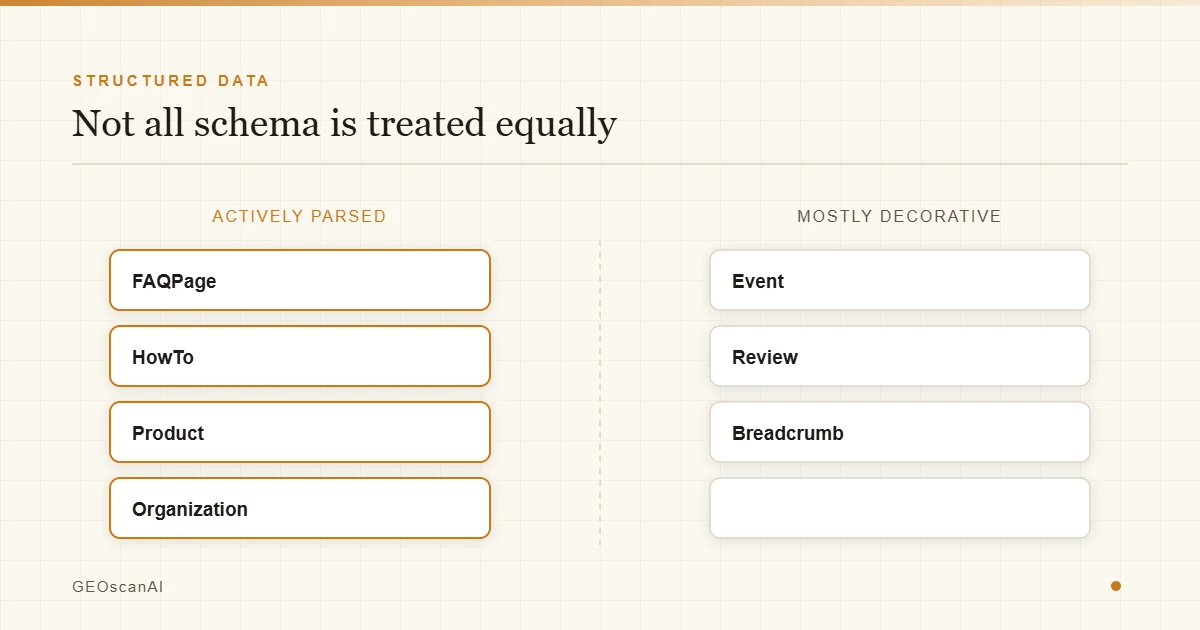
Not all schema markup gets treated equally by AI answer engines. Here's which types actually get parsed and cited, and which are mostly decorative.
Not all schema markup gets treated equally by AI answer engines, and assuming FAQPage schema alone will do the job is one of the more common and costly assumptions in GEO right now. Some schema types get parsed and reflected directly in AI answers. Others are effectively decorative, technically valid, largely ignored by today's major engines.
Why Schema Still Matters When Search Results Aren't the Only Consumer
Schema markup was built for search engines, a way to hand Google and Bing a structured, unambiguous version of your content alongside the messier human-readable page. AI answer engines inherited some of that same appetite for structure, since a clean, unambiguous FAQ block is easier for a model to extract and cite accurately than the equivalent information buried in three paragraphs of marketing prose.
But the inheritance isn't complete or uniform. AI engines are still evolving how much they lean on formal schema versus how much they rely on well-structured visible content, headings, short paragraphs, clear lists, regardless of whether that content is also marked up. Treating schema as a guaranteed lever, rather than one signal among several, is where a lot of GEO effort gets wasted.
The Schema Types That Actually Get Used
FAQPage. This is the most consistently useful schema type for AI extraction. A well-formed FAQPage block, matched to genuinely distinct visible questions and answers on the page, tends to get reflected accurately across most major engines. The key qualifier is genuine: schema that doesn't match what's actually visible on the page, or that stuffs in questions nobody would realistically ask, tends to underperform or get ignored.
HowTo. Numbered, sequential steps for a genuine procedure translate well into AI answers, particularly for retrieval-heavy engines fielding a how-do-I-style question. This only works when the underlying content is genuinely procedural. Forcing HowTo schema onto a conceptual or narrative piece tends to produce schema that looks broken relative to the page it's attached to.
Product. For e-commerce and SaaS pricing pages, Product schema, including price, availability, and review aggregate where genuine, helps an engine answer specific factual questions, like current pricing, accurately rather than guessing or relying on stale training data.
Organization. A well-formed Organization schema block, consistently matched across your site, helps establish the clear identity signal that matters across every kind of GEO work: what you're called, what you do, and how you relate to any similarly named entity.
The Schema Types That Are Mostly Decorative Right Now
Several schema types that matter for traditional search have, at least as of today's model generations, limited observable effect on AI answer content specifically. This includes most Event schema outside narrow use cases, most Review schema beyond the aggregate rating a Product block already carries, and most Breadcrumb schema, which mainly affects how search engines display a URL path rather than how an AI model interprets the page's content.
This isn't a reason to strip these out if you already have them for search purposes, they still serve their original function there. It's a reason not to expect them to move your AI visibility numbers, and not to prioritize adding them specifically for GEO purposes when your time would be better spent on FAQ, HowTo, and Product schema instead.
How to Implement Schema That Actually Gets Parsed
- Start with FAQPage schema on your highest-intent pages, pricing, comparison, and core product pages, matching each schema entry exactly to a visible question and answer on the page itself.
- Add HowTo schema only where the page describes a genuine sequential procedure, and structure the visible content as an actual numbered list, not just the schema markup in isolation.
- Implement Product schema with accurate, current pricing and availability, and update it promptly whenever pricing changes, since stale Product schema can actively contribute to a hallucinated pricing answer.
- Add a consistent Organization schema block sitewide, using the same name, description, and identifying details everywhere it appears.
- Validate every schema block with a structured data testing tool before publishing, and re-validate periodically, since a single malformed field can invalidate an entire schema block silently.
A Common Mistake: Schema That Contradicts the Visible Page
One of the more damaging patterns we see is schema markup that's drifted out of sync with the visible page, an FAQ schema block listing an old price, a HowTo block describing steps that were reordered on the page months ago without the schema being updated to match. This kind of mismatch is worse than having no schema at all, since it risks actively feeding an AI engine a version of your facts that contradicts what's genuinely current.
The fix is procedural, not technical: whoever updates a page's visible content needs to be the same person, or same process, responsible for updating its schema, rather than treating schema as a one-time technical setup task that's separate from ongoing content maintenance.
What Good Schema Coverage Looks Like in Practice
- Pages with well-matched FAQ schema tend to show up as more directly and more accurately quoted in AI answers than equivalent pages without it, based on patterns we've observed across tracked brands, though the effect size varies by category.
- In our audits, we've typically seen a large share of a site's existing schema, where any exists at all, concentrated on decorative types like breadcrumbs, while the higher-leverage FAQ and Product types are thin or missing entirely, which is exactly the gap GEOscanAI's schema checks are built to flag.
- Schema validation errors are more common than most teams expect, since a single missing required field can silently invalidate an entire block, so periodic re-validation catches drift that would otherwise go unnoticed for months.
- Sitewide Organization schema consistency tends to be an easy, one-time fix that pays off across every other schema type on the site, since it reinforces the same identity signal everywhere.
Schema Isn't a Ranking Factor for AI the Way It Was for Search
It's worth separating two different jobs schema has historically done. For traditional search, structured data has sometimes influenced rich results and click-through appearance, a visible, if modest, ranking-adjacent benefit. For AI answer engines, schema's role is closer to translation than ranking, it's not competing your page against others for a slot, it's making your page's content easier to extract accurately once the model has already decided to consider it.
That distinction matters because it resets expectations. Adding FAQ schema to a page that an engine would never have surfaced in the first place, because the underlying content is thin or the brand identity is unclear, won't suddenly make that page competitive. Schema helps an engine extract cleanly from content it's already inclined to consider, it doesn't manufacture consideration from nothing.
A Quick Audit You Can Run on Your Own Site Today
Before rolling out a full schema program, it's worth spending twenty minutes checking where you actually stand. Pull up your five highest-intent pages, pricing, core product pages, and your top comparison or FAQ content, and run each through a structured data testing tool. Note which pages have no schema at all, which have schema that's technically valid but doesn't match the visible content, and which have schema types that fall into the mostly-decorative category described above.
This quick audit alone tends to surface the highest-leverage next step for most sites. Usually it's adding FAQPage schema to a pricing page that doesn't have it yet, or fixing an Organization block that's inconsistent across the site, rather than anything more elaborate. Starting from an actual inventory, rather than guessing at what's missing, keeps the first round of schema work focused on what will actually move the needle.
Where This Fits Relative to Content Quality
Schema is a multiplier, not a substitute. A page with weak, vague, or inaccurate content doesn't become a stronger AI-visibility asset just because it's wrapped in valid FAQPage markup, the underlying answers still have to be genuinely useful and correctly framed. Where schema earns its keep is on pages that already have solid content, by making that content easier for a model to extract cleanly rather than parse out of dense prose. Teams that treat schema as a first step before content quality, rather than a finishing step after it, tend to end up with a lot of well-formed markup wrapped around answers that weren't worth extracting in the first place.
The Takeaway
Schema markup for AI answer engines isn't a checkbox exercise where more is automatically better. FAQPage, HowTo, Product, and Organization schema, implemented accurately and kept in sync with the visible page, are doing real work. Everything else is, at best, along for the ride, and time spent perfecting decorative schema types is time not spent on the ones an AI engine is actually parsing.
Frequently asked questions
Does adding more schema types always improve AI visibility?
No. Several schema types that matter for traditional search, such as most Event and Breadcrumb schema, currently have limited observable effect on AI answer content specifically. FAQPage, HowTo, Product, and Organization schema tend to matter most for AI extraction today.
Can I add HowTo schema to any page to try to get an edge?
We'd advise against it. HowTo schema works best, and looks credible to both engines and readers, when the page genuinely describes a sequential procedure. Forcing it onto conceptual or narrative content tends to produce schema that's out of step with the actual page.
What happens if my schema doesn't match what's visible on the page?
It can actively work against you. Schema that's drifted out of sync with visible content, like an outdated price in Product schema, risks feeding an AI engine facts that contradict what's currently true, which is arguably worse than having no schema at all.
How often should I re-validate my schema markup?
Periodically, and definitely whenever the underlying page content changes. A single missing or malformed field can silently invalidate an entire schema block, so building re-validation into your regular content maintenance process catches drift before it becomes a real problem.