
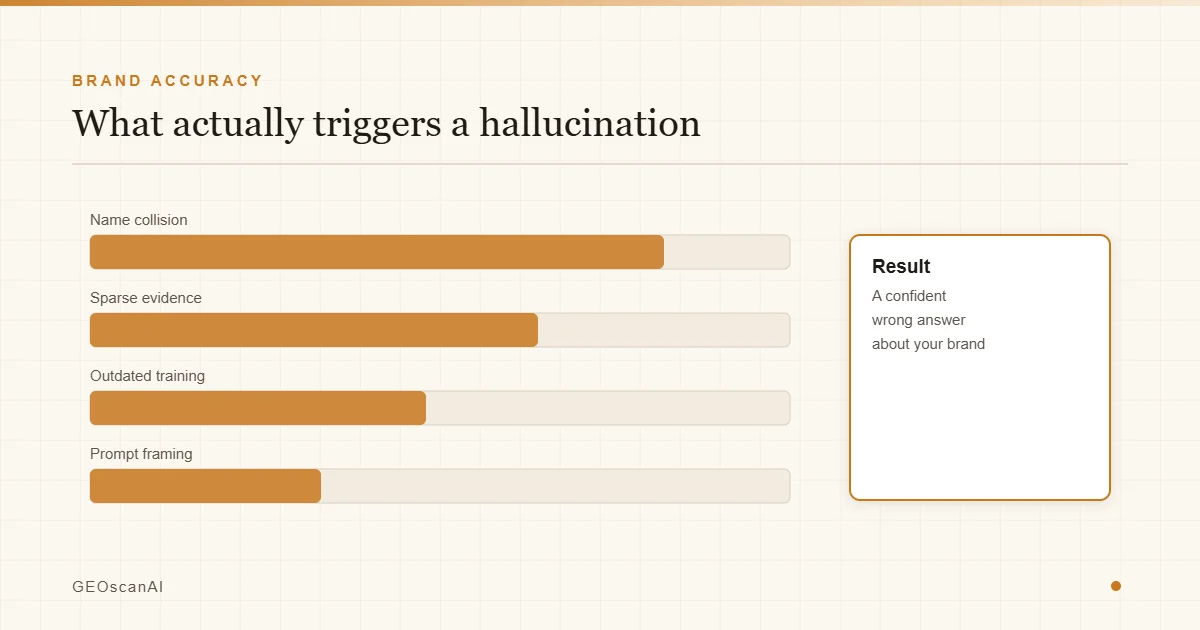
Most AI brand hallucinations trace back to one of four causes: name collisions, sparse evidence, outdated training data, or how the question was framed.
The most common cause of an AI brand hallucination isn't a broken model, it's a name collision the model was never given enough context to resolve. Ask about a brand with a common name, thin source material, or a name shared with something more famous, and a model under-informed about the specific entity will often fill the gap with a plausible-sounding blend of what it does know. That blend is the hallucination.
What Counts as a Hallucination, and What Doesn't
Worth separating early: an AI model being vague, cautious, or declining to answer isn't a hallucination, it's arguably the correct behavior when evidence is thin. A hallucination is specifically when a model states something confidently and incorrectly, inventing a pricing detail that doesn't exist, attributing a product feature your brand doesn't have, confusing you with a competitor, or describing an executive, founding year, or headquarters that's simply wrong.
The distinction matters because the fix differs in each case. Vagueness usually means you need more evidence within the model's reach. A confident wrong answer usually means the model found evidence, but attached it to the wrong entity, or blended two entities together.
Cause 1: Name Collisions With a Better-Known Brand
This is the single most common trigger we see. If your brand shares a name, or a close variant, with a larger or older company, especially one in a different industry or country, models sometimes default to whichever entity has more training-data weight behind it. A small fintech named after a common word, or a regional business sharing a name with an international brand, is especially exposed to this.
The practical signal to watch for: ask an AI engine directly what your brand name does, and see whether the answer describes your actual business or something adjacent that happens to share your name. If it's the latter, you have a disambiguation problem, not a content problem.
Cause 2: Sparse Source Material That Invites Inference
When there isn't much reliable information about a brand, a model doesn't simply say it doesn't know every time, it sometimes infers a plausible answer from category norms instead. Ask about a small SaaS company's pricing when that pricing was never published anywhere clearly, and a model may generate a number that sounds reasonable for the category rather than admit it doesn't actually know. That generated number then reads as fact to the person asking.
This cause is more common for younger or smaller brands, simply because there's less accumulated evidence to constrain the model's guess. It's also more common for pricing, founding details, and specific feature claims than for broad category description, since broad claims are easier for a model to hedge on than specific numbers.
Cause 3: Outdated Training Data Colliding With a Rebrand or Pivot
If your brand changed its name, pivoted its product, or updated a key fact, such as a pricing tier or a leadership change, after a model's training cutoff, older information can persist in the model's answers well after it's stopped being true. This is especially disruptive because the outdated information often isn't wrong in the sense of being invented, it was true once, which makes it harder to catch and easier for the model to state with real confidence.
Cause 4: Prompt Framing That Invites Confident Guessing
How a question gets asked matters more than most brands expect. A prompt that asks a model to compare two named competitors, or to make a specific recommendation, tends to push the model toward a decisive, confident answer, even when its underlying evidence is thin. Open-ended prompts, by contrast, tend to leave more room for a model to hedge or decline. This isn't something you can control directly, since you don't write your customers' prompts, but it explains why the same brand can look accurately described in one conversation and confidently misdescribed in another, depending on how the question was framed.
How the Three Engines Differ
ChatGPT. Because ChatGPT more often retrieves live content, hallucinations here are frequently a retrieval mismatch, the model pulled the wrong page, or a page describing a similarly named entity, rather than a purely invented fact. Publishing clear, crawlable disambiguation content, an About page that states plainly what distinguishes your brand from similarly named entities, tends to help here.
Claude. Because Claude leans more on trained knowledge, its hallucinations skew toward outdated or blended information baked in from training, which is harder to correct through content published today. It generally takes longer for a correction to reach a training-based model's answers, since that requires a future training run, not a re-crawl.
Gemini. Gemini sits closer to ChatGPT in leaning on retrieval and current indexing for many query types, though the exact mix varies by product surface. Disambiguation content and clear structured data tend to help here as well, similar to the retrieval-path fixes that help with ChatGPT.
None of this is a precise technical claim about any model's internals, which aren't fully public and change with each release, it's a practical pattern based on how each engine's answers tend to behave in testing.
A Grey Area: When Sounding Confident Beats Being Right
Not every hallucination is a clean factual error. Some of the trickiest cases are confidently stated approximations, an AI answer that gets the broad category right but invents a specific detail within it, a founding year that's off by a few years, a headquarters city that's plausible but wrong, a feature list that blends your actual product with a close competitor's. These partial hallucinations are harder to catch than an outright wrong answer, because most of what's stated is true, and arguably more damaging, since they're more likely to be believed and repeated by whoever asked.
This is part of why manual spot-checking, asking a model a question yourself once in a while, tends to miss a meaningful share of what's actually happening. A single wrong detail buried inside an otherwise accurate answer is easy to skim past, and unless you're testing the same set of questions repeatedly across multiple engines, you're unlikely to notice a pattern forming.
Why Hallucination Risk Isn't the Same as Visibility Risk
It's worth being clear that hallucination monitoring and visibility monitoring answer different questions. Visibility asks whether your brand gets mentioned at all. Hallucination monitoring asks whether what gets said, once you are mentioned, is actually true. A brand can have strong visibility and a real hallucination problem at the same time, showing up often but described inaccurately, which is arguably a worse outcome than not showing up, since it's actively distributing incorrect information rather than simply being absent.
Treating these as one combined health check tends to hide exactly the cases that matter most. A brand mentioned frequently but described inaccurately looks fine on a visibility-only dashboard, and the actual problem only surfaces once someone is specifically checking for accuracy rather than just presence.
What Actually Reduces Hallucination Risk
- Unambiguous identity content. A clear, specific About page stating your category, your founding details, and what distinguishes you from any similarly named entity gives every engine something solid to anchor to.
- Published facts where a model might otherwise guess. If your pricing, founding year, or key features aren't published clearly somewhere crawlable, assume a model may eventually generate a plausible-sounding but wrong version of them.
- Monitoring, not just prevention. In our tracking across brands, we've typically seen at least a small share of tested prompts produce some kind of factual error across the major engines, meaning close to zero brands are entirely hallucination-free, which is why GEOscanAI treats hallucination monitoring as an ongoing scan rather than a one-time audit.
- A visible correction trail. When a factual error is found and fixed on your site, keeping a dated changelog or update note can help newer crawls pick up the correction faster than a silent edit would.
What to Do If You Find a Hallucination About Your Brand
First, confirm it's actually wrong and not simply an older-but-once-true fact, since the fix differs. For a retrieval-path engine like ChatGPT or Gemini, publish a clear, current correction on a page that's likely to be crawled, and consider directly addressing the specific misconception in FAQ-style content, since that format tends to get pulled into answers efficiently. For a training-path engine like Claude, understand that a published correction may not visibly change answers until a future training run, and set expectations with your team accordingly rather than expecting an immediate fix.
The Takeaway
Hallucinations aren't usually a sign that a model is broken, they're a sign that it was under-informed and asked to answer anyway. The fix is rarely complicated: make sure the specific facts a model might otherwise guess at are published clearly, consistently, and somewhere crawlable, and accept that some engines will pick up the correction faster than others.
Frequently asked questions
Is every wrong AI answer about my brand a hallucination?
Not necessarily. A model being vague or declining to answer isn't a hallucination, it's arguably correct behavior when evidence is thin. A hallucination specifically refers to a confident, incorrect statement, inventing a pricing detail, misattributing a feature, or confusing your brand with another entity.
Why do small or newer brands get hallucinated about more often?
Mainly because there's less accumulated evidence about them online. When source material is sparse, a model sometimes fills the gap with a plausible-sounding inference drawn from category norms rather than stating it doesn't know, and that inference can read as fact to the person asking.
If I correct a wrong fact on my website, how fast will AI answers update?
It depends on the engine. Retrieval-heavy engines like ChatGPT and Gemini can reflect a correction once the page is recrawled and re-indexed, often within weeks. Engines that lean more on trained knowledge, like Claude, may not reflect the correction until a future model training run, which can take considerably longer.
Can I stop AI models from ever hallucinating about my brand?
Not entirely, no engine offers that guarantee. What you can do is reduce the odds by publishing unambiguous identity content and key facts clearly, and by monitoring regularly so you catch and correct errors early rather than finding out from a customer.